Ok...well...it's been a while since I've had time to blog. I've had several projects on the go which have been taking up a lot of my time.
But I'm happy to say that the one that has been giving me the most sleepless nights lately, and the endeavour I'm most proud of, is the arrival of my daughter Emily Ann...
Subscribe to our Growing Gardeners YouTube Channel
Showing posts with label children. Show all posts
Friday, 14 October 2011
Thursday, 15 May 2008
Behind The Scenes - Art Deco
It doesn't happen often, but every now and then, I visit a garden and have a design in mind for it from the moment I see it. This was one of those times.
I had been asked years ago by the previous owners, to give a quote to clean up this garden that surrounded a beautiful art deco home. They never took my radical advice on cleaning up the overgrown nightmare that had become their garden.
Then a couple I had done some landscaping for at their previous home, bought the place and called me in for some advice. They had already made the bold decision of removing most of the plants in the garden, and as a result, had been on the receiving end of a few disapproving looks from their neighbours.
We spoke about their needs from the garden. Privacy and security were big issues, as the house was surrounded by the road on all sides except one. They also wanted a relatively low maintenance garden that would also be a fun place for their 2 children to play and grow up in.
The biggest influence on the design was the strong art deco building, which sat strongly in the middle of the plot. The garden was also roughly split into 3 levels with a pool on the bottom level. The garden felt quite physically disconnected from the house - there was no easy flow from the house into the garden, but was still well connected visually. The terrace and windows all looked down onto the garden from above.
The garden definitely suited a Burle Marx approach to the design - with very strong curves, bold colour combinations and textures that would be appreciated even more when looked down at from above. My clients were fortunately quite trusting, and were happy with the initial sketches.
The budget for the garden was quite limited, with the restoration of the house taking obvious priority. We dug trenches and installed irrigation to lower the long term water costs and maintenance requirements. We had to drop the levels above the pool, and used the soil to raise and level the area around the pool.


I had been asked years ago by the previous owners, to give a quote to clean up this garden that surrounded a beautiful art deco home. They never took my radical advice on cleaning up the overgrown nightmare that had become their garden.
Then a couple I had done some landscaping for at their previous home, bought the place and called me in for some advice. They had already made the bold decision of removing most of the plants in the garden, and as a result, had been on the receiving end of a few disapproving looks from their neighbours.
We spoke about their needs from the garden. Privacy and security were big issues, as the house was surrounded by the road on all sides except one. They also wanted a relatively low maintenance garden that would also be a fun place for their 2 children to play and grow up in.
The garden definitely suited a Burle Marx approach to the design - with very strong curves, bold colour combinations and textures that would be appreciated even more when looked down at from above. My clients were fortunately quite trusting, and were happy with the initial sketches.
The budget for the garden was quite limited, with the restoration of the house taking obvious priority. We dug trenches and installed irrigation to lower the long term water costs and maintenance requirements. We had to drop the levels above the pool, and used the soil to raise and level the area around the pool.


I drew lines on the ground to mark out the grass and planting patterns, and then laid the grass. We kept the existing Cycads and Cycas as feature plants, and used quite tropical style plants. They were planted in groups that contrasted with each other in order to emphasize their outstanding qualities. Some of the bright, bold plants that were used - Bromeliad, Heliconia, Alocasia and Sanseviera. We planted about 8 palms around the building to bring down the scale of the building, which would also not hide the uniqueness of the house.
These pictures were taken 6 months later:
Saturday, 8 March 2008
Behind The Scenes
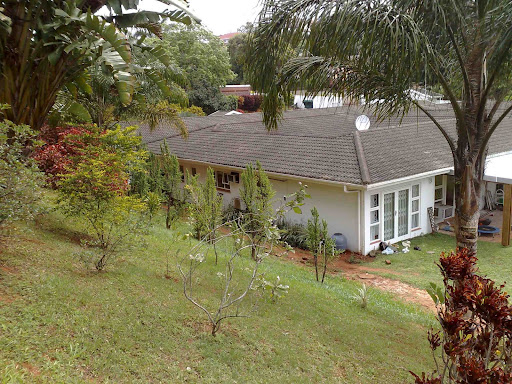
I've just finished a garden for a young family, that wanted to make full use of the garden around them. The area was initially 2 seperate gardens that had the dividing fence taken down and made into a single large garden with a pool and play area for the children.One side had already been planted-up quite well, using almost entirely indigenous plants, while the other side consisted of a flat grassy area, and a steep bank which flanked the house, spotted with a hodge-podge of plants.
When looking at the garden as a whole, I realised that the steep bank was probably the biggest area in the garden. It was almost un-usable because of its steepness - apart from the kids using it as a bit of a natural slide.The soil was poor and sandy, and as a result the grass was only just covering the bank. Over the last decade or so the topsoil was slowly washing down the bank. The effects of which could be seen by the soil level on the side of the house which had slowly risen up to the tops of the drains.
My brief was simple: to landscape the garden and especially the bank, keeping the children in mind.
My first steps were...well...steps. After climbing the bank, I realised that the top of the bank was a really great place to look down on the rest of the garden and surrounds
(in the shade of a wild banana). Getting to the top was less than appealing though!
To make use of the view and bank, I would have to make it easier to get to the top. Straight steps would have been the simplest to construct, but wouldn't have been very enticing, and may also cause erosion issues. I decided a gentle meandering pathway would also be the least strenuous and would create a more interesting journey on the way up.
(I know I'm making this mole-hill sound like a mountain, but people by nature need to have things made as simple, easy and attractive as possible for them to make regular use of them)
After chatting with my client we decided to plant the sunniest part of the bank with wild grasses that would hold-up well with children running up and sliding down them. (I'm also trying to use as much wild grasses as possible - they are beautiful all year round, as well as bringing birds and other animals into the garden as well!)
Work began quickly, with the majority of the plants and grass on the bank dug out and removed or just cut back. We cut back some plants to ground level, on the steepest part of the bank so that the roots would still hold the bank in any heavy rain.
As it turns out, it was a good thing too. After getting the levels right, saturating the soil with copious amounts of compost, we had the first of several December deluges. The rains ran straight down the bank, only to form a small dam against the compost pile, which then proceeded to wash into the now muddy new pool.
The next step was to retain the sides of the pathway, using timber posts sunk, and concreted into the ground. The bank on either side of the pathway was planted up with fast-growing groundcovers and grasses. These would in the shortest possible time, hold the soil in place and look beautiful all year round.
While the planting was progressing I began to see the potential for a tree house in the young Fig on the far side of the bank. The fig itself was too small still for a proper tree-house, but a deck that was built up to, or supported by the fig would be a real inviting place for kids or adults on a hot summer day. I made the suggestion to my clients, who loved the idea, and construction began a short while after.
The 'final' garden is now complete. It will be a while before the garden looks at its best, but it has already begun to blossom. It may need a bit of tweaking in a few months time, with a plant added here or there, but as the saying goes 'a garden is never finished'.


A planting plan of the garden can be found here.
My first steps were...well...steps. After climbing the bank, I realised that the top of the bank was a really great place to look down on the rest of the garden and surrounds
(in the shade of a wild banana). Getting to the top was less than appealing though!To make use of the view and bank, I would have to make it easier to get to the top. Straight steps would have been the simplest to construct, but wouldn't have been very enticing, and may also cause erosion issues. I decided a gentle meandering pathway would also be the least strenuous and would create a more interesting journey on the way up.
(I know I'm making this mole-hill sound like a mountain, but people by nature need to have things made as simple, easy and attractive as possible for them to make regular use of them)After chatting with my client we decided to plant the sunniest part of the bank with wild grasses that would hold-up well with children running up and sliding down them. (I'm also trying to use as much wild grasses as possible - they are beautiful all year round, as well as bringing birds and other animals into the garden as well!)
Work began quickly, with the majority of the plants and grass on the bank dug out and removed or just cut back. We cut back some plants to ground level, on the steepest part of the bank so that the roots would still hold the bank in any heavy rain.
As it turns out, it was a good thing too. After getting the levels right, saturating the soil with copious amounts of compost, we had the first of several December deluges. The rains ran straight down the bank, only to form a small dam against the compost pile, which then proceeded to wash into the now muddy new pool.The next step was to retain the sides of the pathway, using timber posts sunk, and concreted into the ground. The bank on either side of the pathway was planted up with fast-growing groundcovers and grasses. These would in the shortest possible time, hold the soil in place and look beautiful all year round.
While the planting was progressing I began to see the potential for a tree house in the young Fig on the far side of the bank. The fig itself was too small still for a proper tree-house, but a deck that was built up to, or supported by the fig would be a real inviting place for kids or adults on a hot summer day. I made the suggestion to my clients, who loved the idea, and construction began a short while after.The 'final' garden is now complete. It will be a while before the garden looks at its best, but it has already begun to blossom. It may need a bit of tweaking in a few months time, with a plant added here or there, but as the saying goes 'a garden is never finished'.


A planting plan of the garden can be found here.
Tuesday, 18 December 2007
Thorny subjects
Recently, I've been planning a garden, that young children will use. In the past, when designing with children in mind, I've had a few discussions with clients who are concerned about introducing any plants with thorns or similar.
I've spent my childhood playing in large gardens with all kinds of plants, and later moving to a house that bordered a nature reserve with other types of dangers. My parents taught me to be careful of any plants that I didn't know about, and to have a healthy respect for nature.
I really do believe that being given a fair amount of freedom, and not being kept too safe made me into the independent person I am today.
Gardens are like life - they are full of beauty and full of danger, but they help to teach us where our boundaries should be. Sometimes these boundaries are found by standing on thorns, or being stung by insects, sometimes even breaking bones from falling out of trees, but every bit of pain was a valuable lesson learned.
A garden for a child without 'danger' whether imagined or real is boring and lacks stimulation.
Obviously its extremely important not to place life threatening plants or objects into a garden, but to have a completely sterile and safe environment teaches us nothing about life outside the garden.
I've spent my childhood playing in large gardens with all kinds of plants, and later moving to a house that bordered a nature reserve with other types of dangers. My parents taught me to be careful of any plants that I didn't know about, and to have a healthy respect for nature.
I really do believe that being given a fair amount of freedom, and not being kept too safe made me into the independent person I am today.
Gardens are like life - they are full of beauty and full of danger, but they help to teach us where our boundaries should be. Sometimes these boundaries are found by standing on thorns, or being stung by insects, sometimes even breaking bones from falling out of trees, but every bit of pain was a valuable lesson learned.
A garden for a child without 'danger' whether imagined or real is boring and lacks stimulation.
Obviously its extremely important not to place life threatening plants or objects into a garden, but to have a completely sterile and safe environment teaches us nothing about life outside the garden.
Subscribe to:
Posts (Atom)
Home Made Pest Control Solution(s)
I'm really not a big fan of pesticides or chemicals. Actually, that's putting it mildly...I hate pesticides. They are almost always ...
-
So...your lawn is looking amazing. The grass has just been manicured...it looks like an immaculate green carpet out there. You couldn't...
-
Getting rid of pests in gardens is a tough subject. Its never easy watching bugs or other 'pests' eat their way through your beautif...
-
I read a comment the other day that stated quite matter of factly that using wild grasses in your garden is no longer fashionable...what? Wh...


