Subscribe to our Growing Gardeners YouTube Channel

Showing posts with label growth. Show all posts

Friday, 24 April 2009

What does N:P:K stand for, and is it a four-letter word?

I'm asked this often, so here is the short answer:

N : Nitrogen (Good for growth of foliage)
P : Phosphorous (Good for roots and flowers)
K : Pottasium (Good for fruit & general health of the plant)
Four-letter word?: Yes & No


The numbers (e.g. 3:1:5 or 2:3:2) that you see on a bag of fertilizer represent the proportion of these 3 elements - N:P:K.

Some quick facts:
  • A lack of Nitrogen is usually quite apparent when the green foliage of your lawn or plants becomes pale. (Although this is not the only reason for pale leaves)
  • Phosphorous does not move through the soil, so it should only be added in small amounts near the roots of plants, so that it can be absorbed easily.
  • Potassium deficiency shows up when the edges of leaves and the area between the veins start to go yellow. Potassium helps plants handle changes in temperature.
  • Generally speaking, unless the fertiliser is slow release (it will have (SR) after the N:P:K) you should always water your plants straight after applying in order to prevent any burning of the plants, and to help them to absorb the nutrients easily. Wash your hands immediately for the same reason.
  • The plant family Fabaceae (e.g. Peas, Beans, Acacia, Indigofera, Crotalaria) has a symbiotic relationship with bacteria which actually helps add Nitrogen to the soil naturally.
But good-old-fashioned granular or chemical fertilizer is poo-pooed (sorry I couldn't resist that) in many circles these days, rather there is a strong move towards using organic fertilizers instead.

The problem with this particular type of fertilizer has resulted from its over-use, and mis-use. Chemical fertilizers are sometimes applied in larger quantities than can be absorbed by the plants or held by the soil, they then leach down into the groundwater and rivers, and can result in the death of fish amongst other things.
It is also believed that in large quantities over time, they can actually poison the soil and kill off the natural organisms that are essential for plants and organisms in the soil.

My personal opinion is that chemical fertilizers should always be just a very small portion of the food that we provide for our soil and plants. Because the elements are in their basic form, and therefore easily absorbed, they are often great as a short term solution.
But organic fertilizers, such as composts and manures, provide a whole host of other macro and micro nutrients, as well as improving the structure of the soil. For these reasons, they are always better in the long run.

Friday, 3 April 2009

Common Trees with Aggressive Roots

This is a problem I've touched on previously, but I'm amazed at how often people plant or leave trees with strong roots to do their damage. The initial title for this post was going to be: Warning: Trees With Evil Roots. But I can't really call them bad can I? These trees have amazing roots, and as a result they are usually very fast growing, are often able to shrug off many diseases and pests, and are able to withstand drought easily. So really, they are incredibly well-designed plants.

But the problem comes in when they are planted near drains, walls, paving, or in small gardens. The following trees are just the most common trees that I see mistakenly planted:
  1. Ficus (Fig tree)
  2. Erythrina (Coral tree)
  3. Cussonia (Cabbage Tree)
  4. Schefflera (Common Cabbage Tree)
  5. Caesalpinia ferrea (Leopard Tree)
These all have the tendency to damage pathways or drains if planted too near. A couple of restaurants in Durban (Manna Restaurant & Churchill's Coffee Shop) have planted groves of Leopard trees in their outside areas, and while they're great at the moment to sit under, they are doing huge damage to the drains below.


Leopard Trees - Soft and Aggressive

I also often see damage to walls by plants that expand outward, putting pressure on foundations and walls. They are planted when they are still small, but in time get much bigger than anticipated. Some of these are:
  1. Chrysalidocarpus lutescens (Bamboo Palm)
  2. Strelitzia reginae
  3. Many palms are planted while still small, but get much thicker.
Are there any plants that you've noticed in your part of the world that need warning labels?

Wednesday, 18 February 2009

Uh-Oh...

Overlook a Baby Fig Tree at your peril...


It doesn't look like much at the moment, but these amazing plants turn into massive trees - they grow so fast, that you can almost see them growing. Before the owners of this factory know it, half the side of their building will be in pieces. They're not called strangler figs or rock splitters for nothing! If you have one of these in any space smaller than an acre of open ground - be warned. You can see these silent vandals in action here.

Tuesday, 18 November 2008

Beautiful Dirt, Beautiful Plants

Beautiful Dirt? It seems like a bit of an oxymoron, but, yes I think dirt is beautiful! Or at least it should be beautiful. Plants are just like humans, if you get their diet right, they will live long, healthy lives. They'll be less prone to disease, and will look good at the same time.


I've just given a soil sample report to a client, who's garden went through a bit of a rough patch around mid-winter. She called me in to look at the plants in a section of her garden that were looking a bit shabby, and in some cases were being attacked by aphids, scale and downey mildew.

Deciphering a soil analysis, is usually pretty daunting. The key is to know what you're looking for, and what all the figures mean.

The soil report for the 2 samples came back relatively positive, and this is what it looked like:


The report showed that a lack of Nitrogen (Cat2) would most likely be responsible for the poor health of the plants. The report shows that Phosphorous levels are very good, while Pottasium, Calcium, Magnesium, and Sodium levels are all healthy.

Clay content and organic matter is a little low.

Nitrogen is very low, and the pH is much too alkaline (most plants prefer a slightly acidic soil).

There is also the potential for deficiencies of micro-nutrients/elements such as Zinc and Copper, but this would be rectified by adding compost to the soil.

The overall best long-term solution would be to add regular large amounts of compost (as is usually the case) to all the beds, but particularly to the bank area below the house level. This will boost all the levels, but will increase the amount of organic matter in the soil, which in turn will help retain moisture and increase the plants abilities to absorb nutrients.

If chemical fertilizers (a short term solution) are used to boost nitrogen levels, then it is best to use Ammonium Sulphate Nitrogen (27%N) or ASN as this will help improve the pH slightly.

In general this specific report and remedial feeding of the soil could probably be easily applied to most of the Durban coastal surrounds.

The key to healthy plants is in the soil. If you can get the soil right, you take most of the irritating work out of the garden. Its also not something that you are ever finished with. Adding compost and feeding your soil should be a regular process, especially in areas like ours, with sandy soils and high rainfall. Most nutrients leach out of sandy soils very quickly.

But even clay soils can benefit from copious amounts of compost - it helps soften the soil, and reduces compaction. In short, you can never really add too much compost to the average garden to get beautiful dirt, and as a result - beautiful plants.

Friday, 25 July 2008

Silent Green Vandalism

A friend of mine once joked that if there were ever a nuclear explosion in South Africa, the only things that would survive would be the cockroaches and Natal Figs (Ficus natalensis).
In the right place, these beautiful trees can be the crowning glory in a garden. Birds and bats love their fruit, insects love their flowers, and a host of creatures use them as homes and hiding places. They grow easily from seeds or cuttings, and will reach a height and circumference of ±20m if they are in the right place.

They can also be a nightmare if they are left to grow in the wrong place. I have seen countless broken walls that have had a small Natal Fig left to grow in a tiny crack. The leaves and stem are often hacked back, but the roots are incessant. Before you know it they have expanded and done irreparable damage. The roots can often be found at a distance of 2-3 times the radius of the canopy, looking for water. So they should never be planted anywhere near pools or drains.


Because of their amazing roots, they are also commonly known as strangler figs. They are often found growing out of a tiny reservoir of decaying leaves in hollows of other trees, but the roots soon find their way down to the ground, and within a short space of time, they begin to surround and smother their supporting tree. Its actually a very effective way of dealing with unwanted alien trees. (Provided you have the space for a large Fig in its place.)

If you do find a little green vandal growing where it shouldn't be, try to pull the plant out by the roots (if its still young), or cut it back and apply a mixture of diesel and garlon to the cut piece. If you do manage to pull it out, they make great-looking fast-growing bonsai that are easy to look after.

Monday, 17 March 2008

How To Have A Debt Free Garden

Are you in debt with your garden? A post at Garden Wise Guy recently, got me thinking about how often I see gardens with plants planted in the wrong places. Like bad debt, these plants get out of control, causing damage and sapping your energy. The result is usually a completely discouraged gardener.
Decide how in debt you are by asking yourself these questions:
  1. Are you struggling to keep a plant/your garden/lawn under control - as fast as you trim it, its grown back already?
  2. Is a tree or plant getting bigger by the day, and will soon be causing damage to walls, drains, paths etc. but will cost too much to remove?
  3. Are you continually having to cut back plants that want to get bigger than the space allows?
  4. Have you got thorny plants too close to a path, that constantly need cutting back to prevent injury?
  5. Are you feeling overwhelmed by the amount of work needed in your garden?
If you answered yes to most of these questions, then chances are, you're in debt with your garden, and probably see your garden as a chore.

A garden is a lot like money - if planned wisely, it can grow into something of great value. But unfortunately like most of us with bad money habits, we don't invest our plants in the right place. Sometimes the problem becomes so big that we find ourselves in a hole that we can't get out of.

Continuing the financial analogy, the best way to deal with these problems is to:
  • Start with the smallest thing you can manage - get that under control, and it will give you energy for the bigger stuff.
  • Identify potential problems early, and get a plan into place to deal with them.
Obviously, prevention is better than cure. Read up, or ask your local nursery about the plant you are about to plant. Find out how big it gets, or what its roots will do in a few years time.
Rather than continually having to trim it back, plant something that will get to the height/size that you want it to.
If you have huge areas of lawn that require constant maintenance, reduce your lawn size, or even let an area of it grow wild and plant some wild flowers into it.

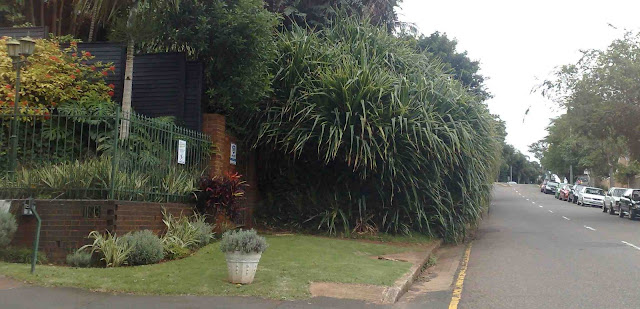
The most common problem plants that I see are Fig trees, Palm Trees, Wild Bananas, and Pandanus. These all start off quite innocently small and attractive, but get out of hand so quickly. Kikuyu grass can also be a nightmare to try and keep under control.

The Pandanus in this photo started off as a small spiralling little plant that is now threatening to move across the road. (You can't see him, but on the other side of the plant is a gardener trying his best to cut it back with a small bush knife!)


Get out of debt, and both you and your plant/garden will be a lot happier for it.

Saturday, 8 March 2008

Behind The Scenes

I've just finished a garden for a young family, that wanted to make full use of the garden around them. The area was initially 2 seperate gardens that had the dividing fence taken down and made into a single large garden with a pool and play area for the children.

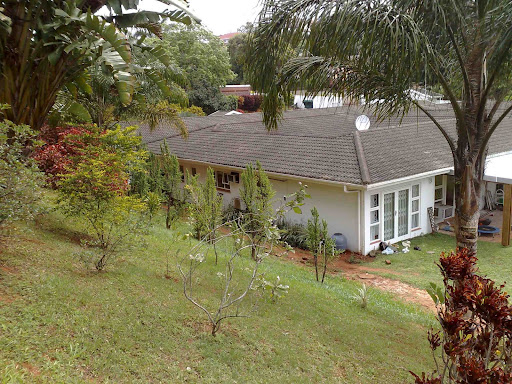
One side had already been planted-up quite well, using almost entirely indigenous plants, while the other side consisted of a flat grassy area, and a steep bank which flanked the house, spotted with a hodge-podge of plants.

When looking at the garden as a whole, I realised that the steep bank was probably the biggest area in the garden. It was almost un-usable because of its steepness - apart from the kids using it as a bit of a natural slide.

The soil was poor and sandy, and as a result the grass was only just covering the bank. Over the last decade or so the topsoil was slowly washing down the bank. The effects of which could be seen by the soil level on the side of the house which had slowly risen up to the tops of the drains.

My brief was simple: to landscape the garden and especially the bank, keeping the children in mind.

My first steps were...well...steps. After climbing the bank, I realised that the top of the bank was a really great place to look down on the rest of the garden and surrounds (in the shade of a wild banana). Getting to the top was less than appealing though!

To make use of the view and bank, I would have to make it easier to get to the top. Straight steps would have been the simplest to construct, but wouldn't have been very enticing, and may also cause erosion issues. I decided a gentle meandering pathway would also be the least strenuous and would create a more interesting journey on the way up.

(I know I'm making this mole-hill sound like a mountain, but people by nature need to have things made as simple, easy and attractive as possible for them to make regular use of them)

After chatting with my client we decided to plant the sunniest part of the bank with wild grasses that would hold-up well with children running up and sliding down them. (I'm also trying to use as much wild grasses as possible - they are beautiful all year round, as well as bringing birds and other animals into the garden as well!)

Work began quickly, with the majority of the plants and grass on the bank dug out and removed or just cut back. We cut back some plants to ground level, on the steepest part of the bank so that the roots would still hold the bank in any heavy rain.

As it turns out, it was a good thing too. After getting the levels right, saturating the soil with copious amounts of compost, we had the first of several December deluges. The rains ran straight down the bank, only to form a small dam against the compost pile, which then proceeded to wash into the now muddy new pool.

The next step was to retain the sides of the pathway, using timber posts sunk, and concreted into the ground. The bank on either side of the pathway was planted up with fast-growing groundcovers and grasses. These would in the shortest possible time, hold the soil in place and look beautiful all year round.

While the planting was progressing I began to see the potential for a tree house in the young Fig on the far side of the bank. The fig itself was too small still for a proper tree-house, but a deck that was built up to, or supported by the fig would be a real inviting place for kids or adults on a hot summer day. I made the suggestion to my clients, who loved the idea, and construction began a short while after.

The 'final' garden is now complete. It will be a while before the garden looks at its best, but it has already begun to blossom. It may need a bit of tweaking in a few months time, with a plant added here or there, but as the saying goes 'a garden is never finished'.


A planting plan of the garden can be found here.

Monday, 25 February 2008

How To Choose The Best Lawn Grass 2

There are a lot of choices when it comes to using plants/grasses as a lawn. Before you choose a type of grass, consider some questions and alternatives in Part 1 of this post.

Below I have included photos of each plant, as well as some of its characteristics:


Axonopus compressus - Kearsney
Copes with: Shade - Low Traffic - Med/High Water
Good Soil - Medium Length - High Maintenance
Best Property : Grows in Shade


Stenotaphrum secundatum - Buffalo
Copes with: Sun/Semi Shade - High Traffic - Medium Water
Average Soil - Medium Length - Low Maintenance
Best Property : Grows in Sun/Shade, Hardy


Cynodon dactylon - Bermuda
Copes with: Sun - High Traffic - Low Water
Poor Soil - Short Length - Low Maintenance
Best Property : Grows in Full Sun, Hardy


Cynodon transvaalensis - Royal Blue
Copes with: Sun - High Traffic - Low Water
Poor Soil - Short Length - Low Maintenance
Best Property : Can be cut as short as 3mm, Full Sun, Hardy


Dactyloctenium australe - Berea Shade
Copes with: Shade/Sun - Medium Traffic - Medium Water
Good Soil - Long Length - Med Maintenance
Best Property : Grows in Shade, Soft


Paspalum vaginatum - Country Club
Copes with: Sun - High Traffic - Low Water
Poor Soil - Short Length - Med Maintenance
Best Property : Hardy


Pennisetum clandestinum - Kikuyu
Copes with: Sun - High Traffic - Medium Water
Poor Soil - Med Length - High Maintenance
Best Property : Tough, Fast growing


Dichondra repens - Wonderlawn
Copes with: Semi/Shade - Med Traffic - Med Water
Good Soil - Med Length - Low Maintenance
Best Property : Grows in Shade


Lysimachia nummularia - Creeping Jenny
Copes with: Sun - Low Traffic - Med Water
Good Soil - High Length - Med Maintenance
Best Property : Attractive golden colour


Mazus reptans - Mazus
Copes with: Semi-Shade - Med Traffic - Med Water
Good Soil - Med Length - Low Maintenance
Best Property : Pretty blue and white flowers


Mentha pulegium - Penny Royal
Copes with: Sun/Semi-Shade - Low Traffic - Med Water
Good Soil - Short Length - Low Maintenance
Best Property : Very Fragrant


Phyla nodiflora - Daisy Lawn
Copes with: Sun/Semi-Shade - High Traffic - Low/Med Water
Poor Soil - Short Length - Low Maintenance
Best Property : Extremely Hardy, stays short with traffic

The next step to look at, is how best to prepare your soil for planting.

If you have any questions, feel free to leave a comment...

Wednesday, 5 December 2007

Four Dimensions

One of the many aspects of landscaping that I enjoy, is taking a thought or an idea, and turning it into a two dimensional drawing, and then into four dimensional reality.

The fourth dimension is time - watching a garden change and grow into the picture that you imagined years before. Seeing in the little seedlings and saplings what they will one day become, is really one of the most satisfying things.

This can also be a frustration. In the beginning stages while plants are still small, and the garden is nothing like what it will become, it is difficult for the client to see the potential inherent in the design. At this point, it comes down to 2 things:

1. Communication

I have really tried to make an extra effort to give realistic expectations of the various stages, but sometimes when everything looks chaotic, its still necessary to reassure the client that in time it will begin to take shape and it really will look as you described!

2. Trust

This is where previous work can help to allay fears. A portfolio can do wonders. Before and after photos do a good job of giving realistic expectations.

Work that comes from referrals is usually fairly pain free, as a certain level of trust has already been assumed.


Home Made Pest Control Solution(s)

I'm really not a big fan of pesticides or chemicals. Actually, that's putting it mildly...I hate pesticides. They are almost always ...