Subscribe to our Growing Gardeners YouTube Channel

Showing posts with label grass. Show all posts

Tuesday, 31 March 2015

Making Mountains Out Of Moles

So...your lawn is looking amazing.  The grass has just been manicured...it looks like an immaculate green carpet out there. You couldn't be more proud of the kingdom you survey. Suddenly, you start to notice little piles of earth being pushed up around your pristine lawn. The ground becomes soft and uneven in places. Where there was once perfection, little brown piles now punctuate your sea of green, taunting your obsessive compulsive side. This means war! How can I get rid of these damn moles!

But before you begin, its important that - in the words of Sun Tzu - you know your enemy.

The first thing you should know is that (if you live in South Africa) there are no moles in your garden.

"But wait!" I hear you say, "I'm definitely not imagining this mess in my garden." Thats true, but moles are not native to Africa. They are a resident of North America, Asia and Europe. What you are actually seeing in your garden is one of either two groups of mole-like creatures that are found in Southern Africa - Golden Moles, or Mole Rats.

Take a look at this cute little Golden Mole (picture credit)
Golden Moles are a distant relative of the hedgehog, and are mainly insectivores, with a predilection for termites. They range in size from 8-20cm, and are covered in a moisture and dirt repellant, black/grey/yellow fur. Their eyes are non-functional, and their ears are just tiny holes, so their sense of touch is highly developed to the point where they can feel termites and other insects nearby. Golden Moles are generally solitary creatures, and can travel great distances (up to as much as 6km in the case of the Grant's Golden Mole) in search of food.  Sadly, 11 of the 21 species of Golden Moles are now threatened with extinction.

Mole Rat caught pink handed (picture credit)
The name Mole Rat is a misleading title, as it is neither a mole, nor a rat.  It is possibly a closer relative to a porcupine. They're herbivores, and enjoy munching on bulbs and grass stolons. Very often eating but not destroying the bulbs that they feed on. They tend to live in family units of up to 14 individuals. Their tunnels are quite extensive, and can go down as much as a 80cm below the surface. Tunnels have been found to be as much as a kilometre in length. They can be quite grumpy little creatures if they are cornered, so take care when handling them.

The second thing you should know about these 2 groups of creatures that we have up till now been mis-calling moles, is that they also perform an important function of aerating the soil, improving drainage, and essentially tilling the soil from underneath.

Thirdly, and most importantly, based on my experience, it is very difficult to get rid of mole rats in particular. I have employed most of them - sonic devices, spinning plastic coke bottles, garlic solutions, urination (not me personally), Jack Russells, and I'm sad to say that when I was younger I even used pesticides. None of these solutions have worked for more than a couple of months, and most didn't work at all. Pesticides seemed to work the best, but you have to weigh up the long term damage that you are doing to the environment. The chemicals are highly toxic, heavier than air and will poison the groundwater, all the surrounding soil, and in the process killing off all the life in the soil. In the long term your grass and plants will end up suffering, as the symbiotic relationship they have with the myriad organisms in the soil will be destroyed.

There are 2 solutions that I have as yet not tried. The first is the use of wire mesh. This involves, essentially spreading galvanised wire mesh over the entire area about 15cm below the surface. The problems with this option are that the wire mesh would have to have a tiny aperture to prevent the moles from squeezing through, it would be quite an expensive option especially for larger areas, and there would be nothing stopping the mole from walking along the surface, and burrowing into the newly fenced off area. But it still may be a good option worth exploring. I would imagine the key would be finding the right depth for the layer of wire to be spread out at.

The second solution is in my opinion the best. At one point I heard about someone who traps moles/mole rats/golden moles alive, and then releases the animals back into the wild far away.  I was never able to get hold of his details. I would have been happy to send him lots of work.

At the moment, the advice that I most often give my clients is more of a remedial one. Prior to regular mowing, any mole hills, and and any surface tunnelling, should be stamped down.
Then during your annual top-dressing, the loose soil can be stamped back down, rolled and then top-dressed to deal with any minor unevenness.
This essentially gives the lawn a fresh start, but the moles will still be there and will eventually work your lawn back to its previous bumpy self.

As with most garden problems that come about from our attempts to control our environment, I believe the best mindset is to work with nature and not against it. The Japanese have a way of thinking called Wabi-sabi, which essentially means embracing imperfection. Something we obsessive compulsive westerners would do well to learn.

Embracing the unevenness, the weeds, the creatures, the yellowing leaves, the non-linear and the imperfect is so hard for us to do, but says so much about our need for control of the world around us. I wonder if it is an outward sign of an impossibility that we expect of ourselves and others around us.

Wednesday, 22 December 2010

Wild Grass Identification Course

If you've been reading this blog for any length of time, you'll know that I'm passionate about indigenous grasses, and I usually look for any opportunity to use them in the gardens I landscape.

If you have a similar fascination for this beautiful, incredibly diverse group of plants, or you want to know more about one of the most threatened plant-types on the planet, or maybe you just love the way they look as they sway in the wind, then you should definitely sign up for a course on identifying wild grasses in Southern Africa.

Wild-grass expert Fritz van Oudtshoorn - the author of the Guide to Grasses of Southern Africa (an easy to use, essential field-guide to identifying grasses) runs courses throughout the country. I was talking to him this morning about the possibility of running a grass identification course here in Durban, and he was quite keen provided there were enough people to attend the course.

If you are interested in grasses, and would like to know more about how to identify them, please email me ASAP to let me know whether you would be keen. The price of the course would be R650 per person and would probably include lunch. The course would probably be around the end of January or beginning of February 2011.

Friday, 12 November 2010

Behind The Scenes - Minimalist, Stone Garden

I've been planning a garden over the last couple of months that has made me quite excited. The house itself is quite contemporary, and in a great setting. Its flanked on one side by 2 magnificent, verdant green fig trees, and on the other side by amazing views over Beechwood Golf Course and out to sea. Its quite close to the existing house next door, which makes for an interesting challenge in trying to soften the views from both sides whilst not creating too much shade.
The owner and the architect had some great ideas, which gave quite strong direction as to what the garden should eventually look like. They wanted to create an almost minimalist, oriental feel with rock and grasses. After several concepts, we settled on a simple approach to the design, which would would require some very large rocks, which would in turn compliment the natural stone that has been used as a strong design element in the house.

Our first step was to remove the alien vegetation on site, which would also open up the views from the house. This would also create more space for the main rock garden area.
The almost blank canvas...
Using the initial concept sketches, I finalised the design, and worked out the position and rough size of the rocks that we would need for the space.


To get a better feel for the size of the rocks, I drew the site on Sketchup, and moved the rocks around to find the best position, shape and size. I wanted to also plan the position of the rocks around the possibility of adding some decking into the design at a later stage.

Sketchup drawing of the area showing the volume of the rocks
The drawings and sketches are more of a guideline to use when the choosing the rocks, because its quite easy to be overwhelmed by the size of the rocks when you're looking at them by themselves in a quarry.
Shorty stands in front of Rock No.9
The tendency is to choose smaller rocks when you're looking at the rocks by themselves. I went into the quarry armed with my sketches showing the shapes and measurements of the rocks that I wanted. I took photographs, and numbered each rock according to the position it was going to fill.

Even with all the preparation there are always a few slight hiccups. Unfortunately this job was no exception. The crane company I had hired to move the rocks got cold feet the day before the rocks were due to arrive. They were nervous because there was no way that we could know (and plan for) the weight of the rocks until they had been weighed on the weigh-bridge and were on their way to site. I had been given figures of anything from 1-7 tonnes per rock. Fortunately, after several anxious hours of phone calls, I managed to get a rigging company - Lovemore Brothers, to step in at the last minute (for a considerably higher fee), to handle the process of moving the rocks from the truck into position.


True to their word, the 55 tonne crane arrived at 7h30 the next morning. After several days of rain I knew that we had a window period of a few hours of good weather, so I began to grow quite anxious when I was told that the rocks were delayed by a broken down truck.

Eventually, at 14h30 the first load arrived, just as the clouds began to roll in. We worked quickly knowing that a storm was approaching, and that we had only a few more hours of light to get the remaining 16 tonnes of stone onto site. We finished the first load as the lightning began to strike around us. (An especially worrying thing when you have a 30-40m lightning-conductor sticking out above everything around it.) The very cold rain began soon after, which was just the precursor to the large hailstones that followed. It seemed like everything that could make our work harder, was going to happen. Fortunately, as is the norm with storms like that in Durban, it didn't last long.

3 long hours later, the second load arrived - just 25 minutes before the cut-off time that Devan (the very capable rigger in charge) had put in place.
With the light fading, and the dangerous prospect of positioning 3 tonne rocks in place in the dark, looming quickly, we tried to work fast. But before we knew it, the light was gone, and we were literally positioning rocks by lamplight.

That's the last rock being lit up with a light in the top left corner
 Next week, I'll do a follow up, showing the completed garden, with the rocks and plants all in place.

Tuesday, 12 October 2010

Why is my grass full of weeds and so patchy?

This has to be one of the most common questions I get asked. I've seen it drive people to all kinds of vices (well not exactly). But I have noticed that in striving for picture perfect lawns people can get quite frustrated as they struggle with weeds taking over the lawn, or patches forming as their lawn becomes sparse.

The answer is usually very simple to diagnose.
Choose a grass that is happy to grow in the shade
Plants are just like us humans. We need the right food, water, rest, space and a pollution-free environment if we want stay healthy. The lack of any of those, causes stress, which makes us prone to disease. And just like diagnosing us humans, if you work out which one or more of those are causing the stress, you've most likely solved the problem.

Follow these steps to isolate the problem:
  1. Water - The most common source of stress on lawns is either too little or too much water. The amount your grass needs depends on many factors. Temperature, wind, soil-type, season all affect the amount of water that your grass consumes. Often the type of weed that's imposing itself on your grass will tell you whether you're giving too much, or too little water. The presence of moss or algae on the soil is a good indicator that there is too much moisture around (they often signal poor drainage). Make sure your irrigation system is correctly adjusted for the seasons. Sandy soils drain very quickly causing the grass to dry out easily. Clay soils become waterlogged, and cause several problems as a result.
  2. Food - Plants have 2 main ways of getting their food - nutrients via the soil, and sugars via sunlight. Lawns almost always love as much sun as they can get. If your lawn is sparse or patchy in the shady areas but looks good in the sunny spots, its most likely due to a lack of light. Thin out the canopy of any trees around the trouble spots by removing some of the branches. Pruning trees right back is almost always the last resort, because they will quite likely grow back thicker than before.
    If light isn't a problem, then you may have a lack of nutrients in your soil. You can get your soil tested quite inexpensively - this will tell you what nutrients are missing and how best to treat your lawn. Generally though, feeding your soil with compost will do wonders for your grass. Compost usually has all the micro- and macro-nutrients your soil needs and will improve the soil over time. Feeding your grass with chemical fertilizers is like feeding your kids nothing but vitamins. It might seem like the same thing as real food, but in the long-term they will have health problems. Organic fertilizers or compost are always best.
  3. Space - Grass needs room to grow - both down and across. If you've had builders on site, make sure they haven't dug a hole in your garden, and buried their rubble, leaving just a shallow layer of soil for your grass to grow in. It sounds ridiculous, but I can't tell you how often I see this done.
    Other short-cuts can also be the problem - if paving or pathways or concrete is too hard to remove, sometimes soil is just used as a cover, and grass is grown over the top. You can usually see the signs during times of drought - a light green weedy patch usually forms over these areas. Thatch (a layer of grass clippings that forms a layer above the soil) can be a problem from time to time, especially if you don't use a grass box when cutting. Diseases and mould can form in this layer, which negatively affects the lawn. Clean out any dead grass cuttings once a year by cutting the grass very short and raking the clippings out.
  4. Rest - If your grass gets a lot of traffic, and it doesn't get enough time to recover properly, bare patches will begin to form. Often, pathways form along the most used areas. Consider formalizing a pathway in these areas, or changing to another type of soil covering i.e. hardy ground-cover, gravel or paving.
  5. Pollution - This can be almost anything that creates a toxic environment for the plants. The most usual suspects are animal urine, soapy water, cement, swimming pool water, fuel or oil from lawnmowers, paint, chemical fertilizers, herbicides and pesticides. If the soil is particularly poisonous, the only route that may be left is to remove the soil and bring in new soil. Often though, water can help leach the offending substance out of the soil. Unfortunately, this only results in the toxins being washed into the groundwater. This may not be a problem with animal urine and some substances that break down easily, but for the most part these substances are causing huge long-term health and environmental problems.
Usually by eliminating one or more of the above factors will dramatically improve the health of your lawn.

Sometimes though, if you are really battling with growing lawn in an area, giving up is actually the best solution of all. As beautiful as a virid green lawn can be, its an addiction that we gardeners have become a slave to - there are very few environmental benefits to a perfect monoculture lawn. Work with nature and plant a mixture of low growing groundcovers instead. Or better still, plant a meadow with wild grasses and flowers.
Like any addiction, only once you stop do you fully appreciate the bountiful benefits.

If you have any questions that I haven't answered about your troublesome lawn, feel free to leave a comment?

Thursday, 16 July 2009

The Search for an Alternative to Lawn...

While walking through a garden this morning, I stumbled on a very strange plant growing as a 'weed' in a very sad lawn. Its the middle of winter here, so most lawns look like they are just hanging on to life by their bare stolons. The only things that seem to be thriving are the weeds.


I noticed the plant, because of its pretty pink flowers - and although there was something quite familiar about it, I didn't think I had seen it before. That is until I looked closer.

The flowers looked very much like the flowers of a ribbon bush - Hypoestes aristata. For those of you that don't know it, its a great indigenous shrub, that gets covered in pink or purple flowers that look like little bits of ribbon spread all over the place. It normally gets to about 1.5 - 2m in height if its left to its own devices. But here its growing quite contentedly - and its being kept regularly cut at about an inch in height! Given time, it will probably happily replace the lawn.


Hypoestes aristata

Hypoestes is a great garden shrub. It likes to be well watered and fed, and if you pay it some nominal attention, it will look good throughout the year. It grows in full sun and shade, but will flower better with more sun.
Its also a favourite snack for most buck along the coastal forest of eastern South Africa - as I found out too late, after planting a garden with it!

Here though, its a great example of the ability of most plants to adapt and thrive in almost any conditions. Without any looking after, its looking green and even flowering. It probably would not have entered my mind, and isn't the ideal, if you're looking for an alternative to lawn. But here it is doing quite well when the grass around it is looking dry and brown.


The search for lawn alternatives hasn't truly begun here in South Africa - the ideal for any SA garden is still a perfect monoculture of grasses that require copious amounts of water and fertiliser, and weekly mowing. But the tide will turn. Eventually. We will begin to realise the real cost of this unsustainable ideal of having most of, and every garden covered in lawn.


The difficulty comes in that, in most peoples minds there is no alternative to a beautiful green lawn - even I sometimes find it hard to imagine anything better. And lets face it very little beats that look of a perfectly mown carpet of grass. But I think its the responsibility of every gardener to help swing the tide by putting alternatives out there. How about a wildflower meadow? Or even planting some indigenous/native grasses to let them grow tall, and cutting pathways through? People want what they see, so we as designers, need to put examples out there to try to coax them out of their comfort zones.

Wednesday, 10 June 2009

Almost Successful Minimalist Front Garden

I'd been waiting in anticipation when I saw the bones of this landscape being formed. I was looking forward to how it would turn out, because it looked like it would be something different to the usual front verge on Essenwood road.


As it turned out, it was different. But to tell you the truth, I was disappointed. Where it had great potential was in its basic structure, but it was let down from that point on.

Everybody has their own opinion on what makes a beautiful design, but there are some basic fundamental things that make a good concept into a good design. And only a good design can be beautiful.

To play with an old saying by St Augustine - In all things sensible compulsory, in all things aesthetic freedom, but in all things passion.

I appreciate the minimalist simplicity of the design, and it probably looked good on paper. Breaking the bank up using terraces was a good practical idea, and the curve gave it something fresh. The huge rocks emboldened the design. The use of Aloes gives a different feel, they're low maintenance, and when they flower, will look amazing.


But the positives can only carry it so far. The first and biggest flaw, is using grass that has to be constantly cut, more than a metre off the ground. Why not use a simple ground-cover, even something as over-used in South African gardens as Mondo grass would have been better from a maintenance point of view. Who wants to lug a lawnmower up onto a terrace?

Why do people over-use white pebbles? Gardeners that use them remind me of magpies that are just attracted to shiny and sparkly things, thinking that the garden will somehow be improved by them. As a general rule, use white pebbles sparingly. They seldom stay white anyway.

You should always be careful using contrast in a garden. There is a very fine line between contrast and kitsch. I believe the design would have been better if the pebbles used had picked up on another colour in the design - whether the rock that they are spread around, the plants used or even the colour of the walls.

In a situation like this, where the rocks themselves are the focus of the design, they should be chosen and positioned deliberately. Japanese garden design has very precise ancient guidelines for using rocks, and while this is not an oriental garden - those guidelines are built around good aesthetics, and should be followed more often than not if you want rock to work well in a design. But that's probably a post for another day. In this case, the third rock looked completely out of place - it was flat and didn't have the presence that the other rocks had.


Another basic mistake made, was not hiding the water valve (it was at least hidden in the standard municipal cover). The design could have been easily adjusted to obscure the box, while still giving access to the meter. It was painted the same colour as the wall, which helps to make it less noticeable.

The choice of Pachpodium as the main feature plant (although it is small it will get a nice size in a few years) for the back of the planting looks slightly out of place - but that's probably just my personal preference rather than any design flaw.

Some of these mistakes are basic, and some might seem nit-picky, but I think this little garden could have been very successful had the person who designed it paid that extra attention to detail, instead I think its been left a little short-changed.

Thursday, 5 March 2009

Why I'm Wild About Indigenous Grasses

I read a comment the other day that stated quite matter of factly that using wild grasses in your garden is no longer fashionable...what? When did wild grasses ever reach any kind of recognition that puts them in the fashionable bracket? I haven't checked recently, but I don't think they want to be fashionable anyway. If anything, I don't think we've even begun to explore the beauty and the practicalities of using bunch type grasses.


Here's a few reasons why I think you should find a corner of your garden to plant some indigenous grasses:
  1. Grasslands need to be protected...Most people are surprised to know that grasslands are the most threatened biome in South Africa, but even more surprising is the fact that the biodiversity of our grasslands is second only to the species richness of our world famous fynbos.

  2. Birds and butterflies and other creatures love grasses...Now I'm not suggesting that by planting wild grasses in your garden, it comes anywhere near to making up for the destruction to this sensitive vegetation type. But by planting grasses, you will definitely attract birds and insects that would normally skip over your garden in search of more hospitable habitats.

  3. Wild Grasses look amazing...From an aesthetic point of view, there is not much that beats the sound and look of tall grasses being blown in the wind, or the early morning dew that sparkles on cobwebs and leaf blades.

  4. Veld Grasses are easy to maintain...There is also not much to maintaining a good sized area of wild grasses. If you consider that once established, you need only cut it back once a year to let the new green growth take over from the old bronzed foliage.

  5. Bunch Grasses are a great way of retaining soil...The roots of most grasses go down fairly deep, and therefore help anchor the soil. So that even in times of heavy rainfall, you can relax knowing that your precious topsoil is not going to be washed out to sea.

  6. Native Grasses conserve water...you need very little water to keep indigenous grass looking good - in fact, you shouldn't really have to water them at all once they are established.

Wherever you are, and whatever you call Veld Grass (Steppes in Russia, Pusztas in Hungary, Pampas in South America, or Prairies in North America), there are a wide selection of plants to choose from that will add an incredible amount of beauty to your garden. I will provide a selection of great indigenous grasses that you can use in your garden in a post soon.

If you still need convincing look at the some of the masters of using wild grass in the garden - Dan Pearson and Oehme & Van Sweden.

Now that I think about it, don't just find a corner to plant some grasses, why not plant your entire garden just using grasses.

Saturday, 18 October 2008

Dealing with White Ants, or How To Control The Universe

Our gardens tell us a lot about ourselves - they often are a reflection of our personality - they reveal our tastes, needs, likes, passions, etc. - but they also sometimes show what we obsess about, what irritates us, and our crazy need to control everything around us.

My guess is that the state of our gardens are probably a good measure of our fragile grip on reality!

Lawns are a perfect example of this - if our lawn is perfect, we console ourselves with the fantasy that we at least have control over some small corner of the universe. And maybe in the uneasy state that is the world's economy, we need to believe we have some control over the universe - as deluded as that may be.


So now that white ant season has hit Durban again, I have a lot more sympathy for the "perfect lawn obsession" that results in the flurry of calls from panicking garden owners asking what can be done to save their lawns from these little "evil" creatures.

There are several ways to deal with termites eating your grass or plants - some more effective than others, but the first step (as in the financial world) is not to panic.
But to deal with them properly its best to understand why they are there...

Most often, they are looking for food. If your lawn has just been laid or recently composted, you may notice an increase in the occurrence of termites. They are present because they have found a new source of food.

They generally also become more noticeable around this time of year, because they are preparing for reproduction and swarming.

I am not a big fan of chemicals, unless the situation is incredibly serious. In most cases applying insecticides is an all-round bad idea - it kills most of the beneficial creatures that live in your soil, and the effects are extremely short-term. They may also make the situation worse in the long term.

The presence of termites is usually easily seen by the fact that the grass starts to look sparse, and small sandy tunnels form above the surface of the soil, or on plants or trees. Make sure that you don't leave anything lying flat on the grass over-night, as the next morning you will usually find the area underneath completely eaten.

I've found that the best way to deal with them, is to disturb these tunnels whenever they are visible, by using the back of a rake, or better yet, give the areas a good spray with water. They usually don't like too much disturbance, and often will move on.

Gardening - as in life, is all about cycles. Sometimes the only control that we can exert is by being patient, doing the basics, and waiting these negative cycles out. Every now and then though, if we look carefully enough, we can find something positive that can be taken out of these crises. Termites are an essential part of the ecosystem - they create habitats, provide food, and make certain nutrients available. The nests also often help the soils absorption of water.

Saturday, 27 September 2008

Behind The Scenes - Long Narrow Garden

About 10 years ago, there was nothing but grass and weeds around this old church building. We used to mow mainly weeds every couple of weeks in order to keep the place tidy, but it never did ever really look tidy.
The church was growing, and so were their needs. This meant that they needed some places to flow out into: for kids to have Sunday school and play, as well as a place to have tea and chat after the service. The existing paving was inadequate, and boring.

Initially we talked about extending the paved areas around the back of the building, but to do this as cost effectively as possible we needed to re-use the existing brick pavers. We bought some basic concrete flagstones, and used the brick pavers to add some detail. The large squares created, helped to reduce the scale and minimise the feeling of narrowness of the area down the side.

The next area that we tackled, was the weedy area on the other side of the building. The plan was to convert it into a low maintenance garden. The church building created a little bit of a problem, as it sheltered the area from the prevailing winds and therefore the rain. To solve this, we sloped waterproof sheeting into the areas that tended to remain dry. This would in effect, cause rainwater to run into the areas that would not get much natural rain.


We cut holes in the sheeting, and planted up the area with succulents, and other low maintenance indigenous plants. To hide the sheeting we spread decomposed granite over the top, and in between the plants.


The last requirement was an area for the children to play in. We considered planting grass, but this would have required weekly cutting, and in such a small area, the likelihood is that the grass would never have looked very good. Eventually a fine gravel was spread over the relatively small area. This was not the ideal solution either, as the children took great delight in using the small stones to block up the drains, and spread them around. It was also not the softest landing for children if they fell, but in lieu of anything better this was the option we stuck with.


This last week we returned to the garden to do a bit of a spruce-up, and to replace the gravel with artificial grass. It looks amazingly real, needs no water or maintenance, and can be played on without dying off in patches. This seems to be the ideal solution for this area.

Tuesday, 29 July 2008

Overheard: GOD and St. Francis talking about our lawns

My Sister-in-law sent this to me today. If you were wondering what God thinks of our gardens and lawns, read on...

GOD: St. Francis, you know all about gardens and nature. What in the World is going on down there on Earth? What happened to the dandelions, violets, thistle and stuff I started eons ago? I had a perfect, no-maintenance garden plan. Those plants grow in any type of soil, withstand drought and multiply with abandon. The nectar from the long lasting blossoms attracts butterflies, honeybees and flocks of songbirds. I expected to see a vast garden of colors by now. But all I see are these green rectangles.

ST. FRANCIS: It's the tribes that settled there, Lord. The Suburbanites. They started calling your flowers weeds and went to great lengths to kill them and replace them with grass.

GOD: Grass? But it's so boring. It's not colorful. It doesn't attract butterflies, birds and bees, only grubs and sod worms. It's temperamental with temperatures. Do these Suburbanites really want all that grass growing there?

ST. FRANCIS: Apparently so, Lord. They go to great pains to grow it and keep it green. They begin each spring by fertilizing grass and poisoning any other plant that crops up in the lawn.

GOD: The spring rains and warm weather probably make grass grow really fast. That must make the Suburbanites happy.

ST. FRANCIS: Apparently not, Lord. As soon as it grows a little, they cut it, sometimes twice a week.

GOD: They cut it? Do they then bale it like hay?

ST. FRANCIS: Not exactly Lord. Most of them rake it up and put it in bags.

GOD: They bag it? Why? Is it a cash crop? Do they sell it?

ST. FRANCIS: No, sir -- just the opposite. They pay to throw it away.

GOD: Now, let me get this straight. They fertilize grass so it will grow. And when it does grow, they cut it off and pay to throw it away?

ST. FRANCIS: Yes, sir.

GOD: These Suburbanites must be relieved in the summer when we cut back On the rain and turn up the heat. That surely slows the growth and saves them a lot of work.

ST. FRANCIS: You aren't going to believe this, Lord. When the grass stops growing so fast, they drag out hoses and pay more money to water it so they can continue to mow it and pay to get rid of it.

GOD: What nonsense. At least they kept some of the trees. That was a Sheer stoke of genius, if I do say so myself. The trees grow leaves in the spring to provide beauty and shade in the summer. In the autumn they fall to the ground and form a natural blanket to keep moisture in the soil and protect the trees and bushes. Plus, as they rot, the leaves form compost to enhance the soil. It's a natural circle of life.

ST. FRANCIS: You'd better sit down, Lord. The Suburbanites have drawn a new circle. As soon as the leaves fall, they rake them into great piles and pay to have them hauled away.

GOD: Nooo. What do they do to protect the shrub and tree roots in the Winter and to keep the soil moist and loose?

ST. FRANCIS: After throwing away the leaves, they go out and buy Something which they call mulch. They haul it home and spread it around in place of the leaves.

GOD: And where do they get this mulch?

ST. FRANCIS: They cut down trees and grind them up to make the mulch.

GOD: Enough! I don't want to think about this anymore. St. Catherine, you're in charge of the arts. What movie have you scheduled for us tonight?

ST. CATHERINE: Dumb and Dumber, Lord. It's a real stupid movie about.............

GOD: Never mind, I think I just heard the whole story from St. Francis.

Saturday, 19 July 2008

Are things Black & White, or Shades Of Green?


As I said in a previous post I was admiring how green the grass on the artificial side is. But according to a book that I picked up today - Shades of green by Paul Waddington, in his chapter on grass, he says about artificial grass:
...it will need replacing after as little as fifteen years; it's made from fossil-fuel-derived products and it performs none of the CO2 absorption, water purification, pollution absorption or wildlife habitat services that a real lawn will provide. Won't smell nice, either. So artificial grass's status as a big sheet of dead stuff in the middle of your garden condemns it to the least green spot.
His assessment of the 'greenness' of grass was that a Wildflower meadow would be regarded as Deep Green, while a home grown, infrequently mown, unwatered lawn would be Dark Green.
If you're striving for a perfect lawn, you would be considered pale green.

The book had an interesting perspective - looking at the topic of how green various things are; from cars to bananas to the internet.
It was written in a light humorous way, but I wasn't sure how factual all his assessments were. I also thought having a chapter explaining which drugs were and were not green friendly was a little irresponsible.

There were a couple of surprises though. Apparently, green-blogging is an oxymoron? The use of the internet left a quite large carbon footprint, especially compared to TV or newspapers.

It did leave me thinking that awareness and balance, are most important. I may never be a 'dark greeny', but then maybe that's not so bad?

Thursday, 10 July 2008

Is the grass greener on the artificial side?

After years of mockery, belittling and ridicule of the fake plant brigade, I'm going over to the dark side. Ok, I'm not going over all the way. I'm just going over to admire the artificial grass.
I've always been adamant that there is no proper place for fake in gardening - gardens are one of the few places that are real in the high-tech, modern lives we lead. (There is little place for gnomes in my gardens... unless they are real of course).


But lately I've found myself looking at artificial grass in a different light. Its got a lot going for it that I couldn't see when I couldn't see past the word "artificial":

1. It doesn't need any water. In our water conserving times, this is a big plus. Anything that stays green, and doesn't need to be watered twice a week deserves a little recognition.

2. It's durable. It will take a fair amount of traffic without looking untidy or worn.

3. It doesn't need to be trimmed. For those of you who find the process of mowing lawns cathartic, you can close your eyes for this one. But the costs in time, labour and resources in keeping a lawn in perfect condition can be a strong argument against lawns.

4. It seems to be much improved from the strange green colour and texture that it used to have. There seems to be better and more choices these days.

5. There is also the argument that large areas of grass are artificial anyway, and do little for the environment anyway.

I'm not arguing that artificial grass is on an equal footing with grass - it isn't. For one thing, that feeling of walking barefoot on cool grass can't be replaced.
I think the place for artificial grass is for areas where the look of a lawn is what's needed, but for any number of reasons it won't grow without undue amounts of work to keep it looking at its best.

Will you be going over to the dark side?

Sunday, 8 June 2008

A Perfect Winters Day


Yesterday was one of those perfect winter days - warm enough that you could sit in the sun and feel toasty but not hot. We went for a walk in Kloof Gorge, to take some photos of the red hot pokers that were sitting proudly above the dry winter grass.

On the way back I started to notice a scattering of these Helichrysums in the veld. The flowers were already dry and silvery, but seemed to reflect the sun like little mirrors in the grass.
The flowers are probably several weeks old now, and if the veld isn't burnt too soon they'll probably look just as good for a few more weeks. (True to their common name - Everlasting)


I changed the photos to black and white to show how striking the silvery flowers really are.

The only blight on the day was discovering hundreds of tiny little red ticks the size of pin-heads on my ankles. I had to spend the next half an hour making sure they were all off me.

Tuesday, 20 May 2008

Those Happy Sods


I was collecting some grass today. I had to take a picture of these little rolls all lined up and ready for me. They almost looked happy to see me?

I also learnt today, that if you need to get rid of nut grass in your lawn, you can use a great herbicide called Servian. It can be used on most lawns, as it only affects Cyperus spp. - provided you get the correct dosage.

That should save a lot of man hours trying to pull all the pesky plants out of my lawns!

Thursday, 1 May 2008

Plant Some Weeds In Your Lawn

I found this quote the other day...
The difference between a flower and a weed is a judgement - Anonymous
Having a beautiful lawn can be an all consuming focus of gardeners and homeowners. You'd be right in thinking that a well manicured lawn can be an asset in the garden, but part of the reason why lawns are such hard work, is that we are trying to maintain a completely false state in our gardens.

The perfect lawn that everyone is striving for is a monoculture. Mother Nature and monocultures are not friends. She does her best to mess up anything that even resembles one.

One of the most maligned plants in a perfect lawn is clover. How can I get rid of clover in my lawn, is one of the most common questions I am asked.

First, you need to identify the plant - there are 2 plants that moonlight as clover, Trifolium(Clover) and Oxalis. They are easily identified by their flower.


Clover - Trifolium


Sorrel - Oxalis

Sorrel just looks pretty but isn't the good, industrious Clover. Trifolium is a nitrogen fixer. This means it works hard to take nitrogen out of the air and put it into your soil. Your hungry grass on the other hand, does its best to use Nitrogen up and always wants more. If your lawn is looking anaemic and yellow, generally speaking, it is short on Nitrogen.
Most times, we like to take the easy route out - we apply bag after bag of fertiliser to try and put the Nitrogen back into the soil.

Maybe its time we let Clover and grass share some space. We'd probably all be the happier for it.

Wednesday, 23 April 2008

Indigenous Beauties : Helichrysum kraussii


Helichrysum kraussii
Straw Everlasting

Helichrysum kraussii is often found growing in colonies in grasslands. It loves a sunny spot, and doesn't need very much water to thrive.

It can grow up to 1 metre if left to its own devices, and does become woody at its base. The foliage is a wonderful downy grey, and releases a pungent aroma when touched - especially in warm weather. The flowers dry superbly.

Sunday, 6 April 2008

How To Grow The Best Lawn Grass 4


Once you've prepared your earth, the next question to consider is - how do I begin growing/laying my grass? There are several methods to beginning a new lawn:
  1. Grass Sods (Instant Lawn)
  2. Plugs
  3. Seed

1. Instant Lawn

Laying instant turf is the quickest and easiest method to getting a brand new lawn.

Give the area to be planted a good soaking the day before. This will make sure that the sods don't get dried out by the soil that they are being planted on, but will still be dry enough to work on.

If there is going to be any delay between the grass being supplied to you and being planted, then its best to leave it in a cool place for the maximum of a day. Don't water the rolled up sods, as the absence of light/air and presence of water will begin the decomposition process.

Once you are ready for planting, lay a border of grass around the edges. This gives a neater overall look to your new lawn.
Then begin laying your grass in a direction parallel to where it will mainly be viewed from. This will look better in the short term until the grass knits together and the lines between the sods are less evident.
When you are finished, give the lawn a light roll, and a light sprinkling of water to help ensure that the turf has bonded with surface of your soil.

For the next 2 weeks, water the grass every day, giving it just a light sprinkling - it doesn't have deep roots yet, so too much water and it will drop below the roots and be wasted. Thereafter, water every 2-3 days depending on the weather.

Once the grass has established you can give it a light topdressing to even out any unevenness.

2. Plugs

Plugs are a good option when cost is an issue. The plugs can be planted as far apart as necessary. The ideal spacing is 15-20cm.

As for instant grass above, give the area a good soaking the day before. Start from the furthest point and work backwards. Stand on a plank to distribute your weight evenly and keep from compacting the soil. Use a dibber, or small pointy stick to make the holes in the ground.
Place the plug into the hole, making sure that there is no air pocket below the roots. Carefully press the soil down and towards the newly positioned plug to make sure that it is firmly in place.

When you are finished, you can give the surface a light roll, and a light sprinkling of water.

As for instant turf above, for the next 2 weeks, water the grass every day. Thereafter, water every 2-3 days depending on the weather.

Once the grass has established you can give it a light topdressing to even out any unevenness.


3. Seeds

Planting grass by seed can be the trickiest method, but the satisfaction of watching thousands of little seedlings germinating is sometimes worth it.

The main thing to keep in mind is the fragility of these baby plants in their first few days of life.
Seed suppliers will often give specific directions for planting. Their instructions should be followed as much as is possible.

For best results, spread the seeds evenly by hand for small areas or with a fertiliser spreader for larger areas.
Spread a very thin, fine layer of soil over the top, or give a careful light raking to allow the seeds to be covered by about 5-8mm of soil.

Water once a day, giving the seeds/grass a very fine sprinkling, until the grass reaches about 50mm in height.

Monday, 24 March 2008

How To Grow The Best Lawn Grass 3

After looking at whether you should be using grass, and what types of groundcover are best suited to your garden. The next step to consider, is how is your earth?

Soil is probably the biggest factor (that we can control), that has the most effect on the health of a lawn. Strangely enough its usually the part that most people give the least consideration to.

The ideal earth for most lawn grasses is a sandy loam soil with a pH of between 6 and 7. Too much sand and the water and nutrients leach away from the roots too quickly. Too much clay, and the roots sit in water for too long and don't get enough oxygen. The earth should go to a minimum depth of 150-200mm.

If you are looking to improve your soil - whether you have too much clay or sand, then you can't go wrong by adding copious amounts of compost. The compost adds nutrients to sandy earth, and has the effect of breaking down the hardness of clay soil. The costs may be higher to begin with, but over time the amount of work - weeding, fertilising or repairing will be reduced considerably.

Preparation of the area should involve the following:
  1. Remove any rubble or debris in the soil.
  2. Remove all weeds. If time is not an issue then allow the site to stand empty for a few weeks to allow any weeds to germinate, and then remove them by hand. Post-emergence herbicides can be used instead - but these should only be used if weeds are a serious problem.
  3. Level the area to be grassed, paying close attention to the slope of the soil. Make sure that water can drain away easily, and will drain away from buildings and pools.
  4. Add compost (weed free and completely decomposed is essential), and superphosphates (±30g per m2).
  5. Dig the compost and superphosphates into the top 100-200mm of earth.
  6. Adjust and even out final levels.
  7. Roll the soil to ensure an even surface. However, if the soil has even a medium clay content, never roll the soil when wet. This will compact the soil, and squeeze out any oxygen in the soil.
There are several methods of planting grass - each with their own advantages and disadvantages. These will be dealt with in a following post.

Monday, 17 March 2008

How To Have A Debt Free Garden

Are you in debt with your garden? A post at Garden Wise Guy recently, got me thinking about how often I see gardens with plants planted in the wrong places. Like bad debt, these plants get out of control, causing damage and sapping your energy. The result is usually a completely discouraged gardener.
Decide how in debt you are by asking yourself these questions:
  1. Are you struggling to keep a plant/your garden/lawn under control - as fast as you trim it, its grown back already?
  2. Is a tree or plant getting bigger by the day, and will soon be causing damage to walls, drains, paths etc. but will cost too much to remove?
  3. Are you continually having to cut back plants that want to get bigger than the space allows?
  4. Have you got thorny plants too close to a path, that constantly need cutting back to prevent injury?
  5. Are you feeling overwhelmed by the amount of work needed in your garden?
If you answered yes to most of these questions, then chances are, you're in debt with your garden, and probably see your garden as a chore.

A garden is a lot like money - if planned wisely, it can grow into something of great value. But unfortunately like most of us with bad money habits, we don't invest our plants in the right place. Sometimes the problem becomes so big that we find ourselves in a hole that we can't get out of.

Continuing the financial analogy, the best way to deal with these problems is to:
  • Start with the smallest thing you can manage - get that under control, and it will give you energy for the bigger stuff.
  • Identify potential problems early, and get a plan into place to deal with them.
Obviously, prevention is better than cure. Read up, or ask your local nursery about the plant you are about to plant. Find out how big it gets, or what its roots will do in a few years time.
Rather than continually having to trim it back, plant something that will get to the height/size that you want it to.
If you have huge areas of lawn that require constant maintenance, reduce your lawn size, or even let an area of it grow wild and plant some wild flowers into it.

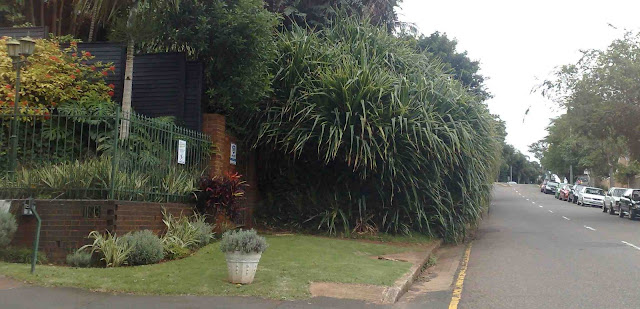
The most common problem plants that I see are Fig trees, Palm Trees, Wild Bananas, and Pandanus. These all start off quite innocently small and attractive, but get out of hand so quickly. Kikuyu grass can also be a nightmare to try and keep under control.

The Pandanus in this photo started off as a small spiralling little plant that is now threatening to move across the road. (You can't see him, but on the other side of the plant is a gardener trying his best to cut it back with a small bush knife!)


Get out of debt, and both you and your plant/garden will be a lot happier for it.

Saturday, 8 March 2008

Behind The Scenes

I've just finished a garden for a young family, that wanted to make full use of the garden around them. The area was initially 2 seperate gardens that had the dividing fence taken down and made into a single large garden with a pool and play area for the children.

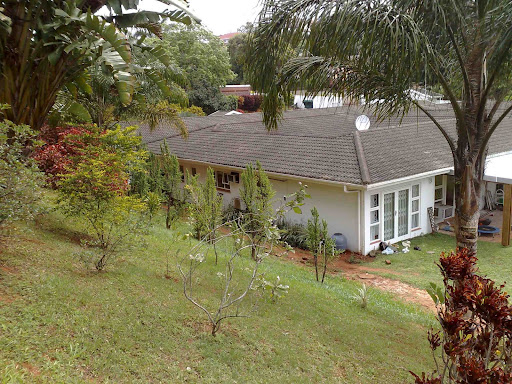
One side had already been planted-up quite well, using almost entirely indigenous plants, while the other side consisted of a flat grassy area, and a steep bank which flanked the house, spotted with a hodge-podge of plants.

When looking at the garden as a whole, I realised that the steep bank was probably the biggest area in the garden. It was almost un-usable because of its steepness - apart from the kids using it as a bit of a natural slide.

The soil was poor and sandy, and as a result the grass was only just covering the bank. Over the last decade or so the topsoil was slowly washing down the bank. The effects of which could be seen by the soil level on the side of the house which had slowly risen up to the tops of the drains.

My brief was simple: to landscape the garden and especially the bank, keeping the children in mind.

My first steps were...well...steps. After climbing the bank, I realised that the top of the bank was a really great place to look down on the rest of the garden and surrounds (in the shade of a wild banana). Getting to the top was less than appealing though!

To make use of the view and bank, I would have to make it easier to get to the top. Straight steps would have been the simplest to construct, but wouldn't have been very enticing, and may also cause erosion issues. I decided a gentle meandering pathway would also be the least strenuous and would create a more interesting journey on the way up.

(I know I'm making this mole-hill sound like a mountain, but people by nature need to have things made as simple, easy and attractive as possible for them to make regular use of them)

After chatting with my client we decided to plant the sunniest part of the bank with wild grasses that would hold-up well with children running up and sliding down them. (I'm also trying to use as much wild grasses as possible - they are beautiful all year round, as well as bringing birds and other animals into the garden as well!)

Work began quickly, with the majority of the plants and grass on the bank dug out and removed or just cut back. We cut back some plants to ground level, on the steepest part of the bank so that the roots would still hold the bank in any heavy rain.

As it turns out, it was a good thing too. After getting the levels right, saturating the soil with copious amounts of compost, we had the first of several December deluges. The rains ran straight down the bank, only to form a small dam against the compost pile, which then proceeded to wash into the now muddy new pool.

The next step was to retain the sides of the pathway, using timber posts sunk, and concreted into the ground. The bank on either side of the pathway was planted up with fast-growing groundcovers and grasses. These would in the shortest possible time, hold the soil in place and look beautiful all year round.

While the planting was progressing I began to see the potential for a tree house in the young Fig on the far side of the bank. The fig itself was too small still for a proper tree-house, but a deck that was built up to, or supported by the fig would be a real inviting place for kids or adults on a hot summer day. I made the suggestion to my clients, who loved the idea, and construction began a short while after.

The 'final' garden is now complete. It will be a while before the garden looks at its best, but it has already begun to blossom. It may need a bit of tweaking in a few months time, with a plant added here or there, but as the saying goes 'a garden is never finished'.


A planting plan of the garden can be found here.

Home Made Pest Control Solution(s)

I'm really not a big fan of pesticides or chemicals. Actually, that's putting it mildly...I hate pesticides. They are almost always ...